Blood Manager · Educational content

What is Patient Blood Management (PBM)?

A systematic, patient-centered and evidence-based approach to preserving Blood Health and improving clinical outcomes.

Patient Blood Management reorganizes care to identify and treat anemia, reduce blood loss, optimize hemostasis and individualize transfusion decisions. More than an isolated protocol, it is a model of care that places the patient at the center of blood-related decisions.

Definition

Patient Blood Management is a model of care

PBM represents a structural transformation in blood-related care. Rather than treating transfusion as an automatic response to anemia or blood loss, the model anticipates problems, organizes processes and individualizes clinical management.

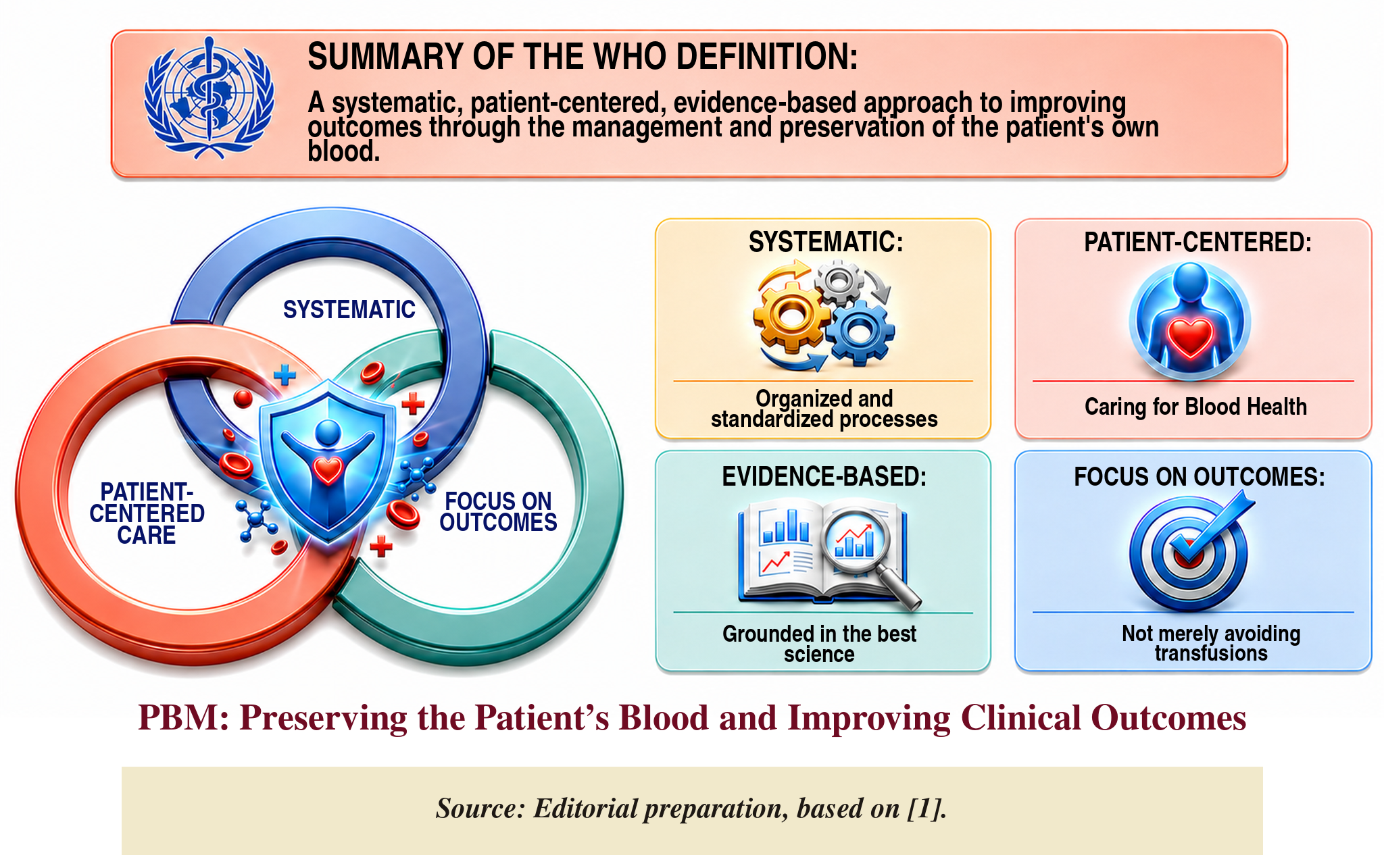
At its core, PBM seeks to improve clinical outcomes through the management and preservation of the patient’s own blood using a systematic, patient-centered and evidence-based approach.

This means recognizing anemia and bleeding as clinical problems to be investigated and treated, valuing Blood Health and reserving transfusion for situations in which its benefits clearly outweigh the risks.

Visual summary of Patient Blood Management: a systematic, patient-centered, evidence-based approach focused on outcomes
Conceptual summary of Patient Blood Management as presented in PBM Essencial: Transformando o Cuidado, Salvando Vidas.
Clinical framework

The Three Pillars of Patient Blood Management

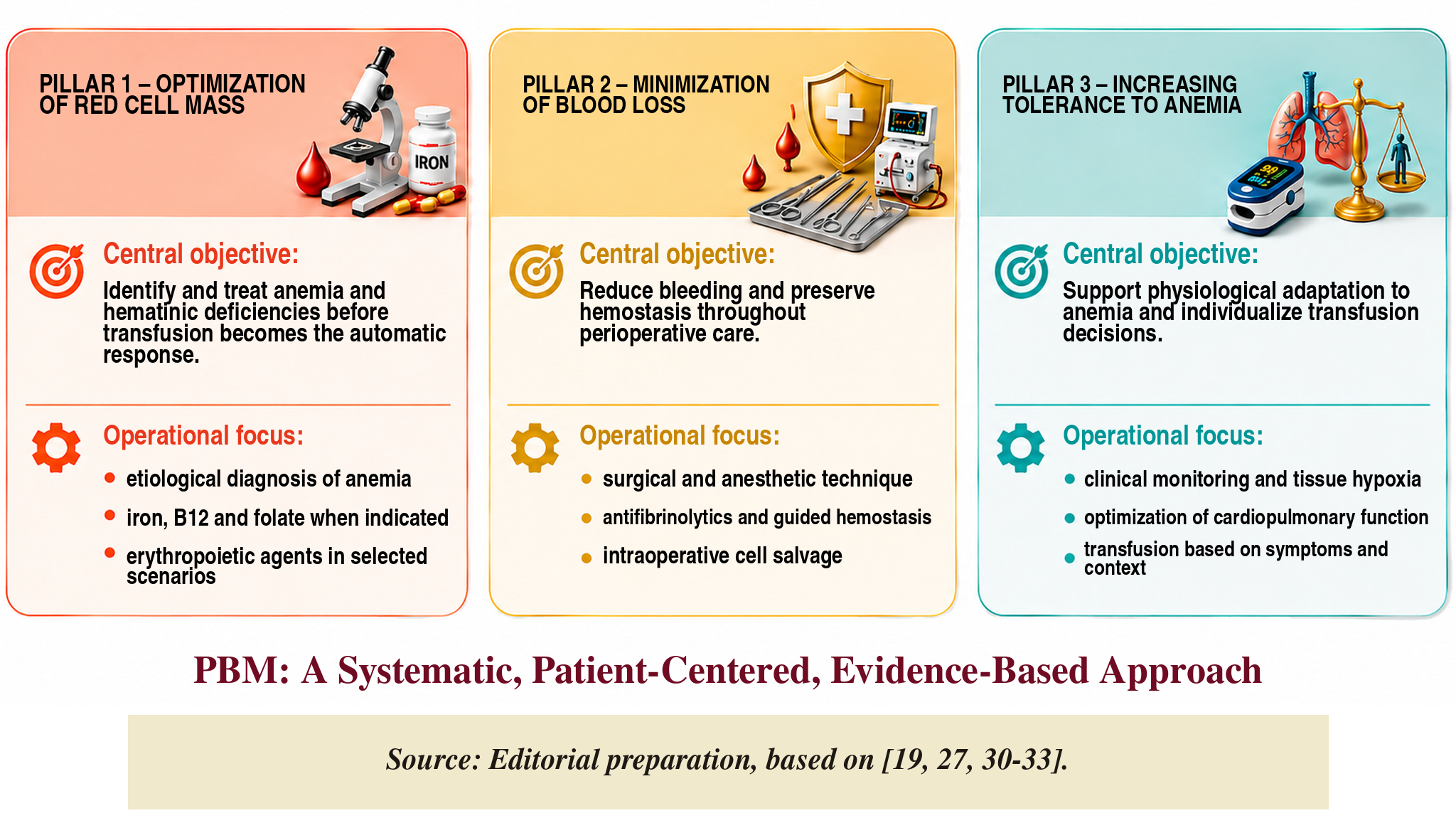
The pillars are interdependent and should be applied throughout the patient journey in an integrated and individualized manner.

1

Optimization of red cell mass

Identify and treat anemia and hematinic deficiencies before transfusion becomes an automatic response. Etiological investigation, management of iron deficiency and correction of other treatable causes play a central role.

2

Minimization of blood loss

Reduce bleeding and preserve hemostasis throughout all phases of care. This includes planning, surgical and anesthetic techniques, antifibrinolytics, guided hemostasis and intraoperative cell salvage in appropriate settings.

3

Optimization of physiological tolerance of anemia

Recognize the physiological capacity to adapt to anemia and individualize the transfusion decision. Symptoms, clinical context, comorbidities and signs of hypoxia matter more than an isolated hemoglobin value.

The three pillars of Patient Blood Management: optimization of red cell mass, minimization of blood loss and optimization of physiological tolerance of anemia
The Three-Pillar PBM framework presented in PBM Essencial: Transformando o Cuidado, Salvando Vidas.
An essential point

PBM does not mean “do not transfuse”

Patient Blood Management is not an anti-transfusion approach. Blood transfusion can be useful and potentially lifesaving when appropriately indicated.

PBM proposes changing the logic of decision-making: investigate and treat modifiable causes, reduce avoidable losses and assess transfusion needs carefully, contextually and based on evidence.

The goal is not to reach “zero transfusion,” but to ensure that each patient receives the most appropriate treatment for their clinical condition with the lowest possible risk.

“Beyond reducing transfusions, PBM reorganizes care to preserve the patient’s Blood Health and improve clinical decision-making.”

Educational summary · Blood Manager
Why implement PBM

Clinical, economic and ethical benefits

The literature reviewed in PBM Essencial shows that structured PBM programs may provide benefits beyond reducing the use of blood components.

Evidence

Multimodal programs and core PBM strategies have been associated, in the settings studied, with lower transfusion exposure, fewer complications and improved clinical outcomes.

Economics

More rational use of blood components, fewer complications and organized care may reduce direct and indirect costs and contribute to healthcare sustainability.

Ethics

PBM reinforces autonomy, shared decision-making, beneficence, non-maleficence and distributive justice in the use of a valuable and limited biological resource.

Multimodal PBM meta-analysis

Among 235,779 surgical patients, a multimodal PBM program was associated with a 20% reduction in total complications and an 11% reduction in mortality. These findings apply to the body of studies evaluated and do not guarantee individual benefit.

Health-system experience

In Western Australia, a large-scale PBM program was associated with risk-adjusted reductions in hospital mortality, hospital-acquired infections and cardiovascular events, as well as savings related to blood component use.

Beyond transfusion

PBM and Blood Health

Blood Health broadens the focus to the patient’s hematological condition throughout the care journey. Blood is no longer viewed only as a transfusion product, but as an essential component of physiology, safety and clinical outcomes.

In this context, the Three Pillars explain how PBM works. The Three Ps express what care aims to achieve: promote the best possible hematological condition, protect life from unnecessary blood loss and exposure, and prevent avoidable causes of anemia and bleeding.

PromotionSeek the best possible hematological condition for each patient.
ProtectionProtect the patient from blood loss and unnecessary exposure.
PreventionAct early on avoidable causes of anemia and bleeding.
Integrated care

PBM is multidisciplinary

Effective implementation requires collaboration among different professionals and areas of care. Surgeons, anesthesiologists, physicians, intensivists, hematologists, nurses, pharmacists, perfusionists, managers and other professionals contribute complementary expertise.

Patients and their families also play a central role, especially in education, understanding therapeutic alternatives and shared decision-making.

Hematology and Transfusion MedicineAnesthesiologySurgeryIntensive CareNursingPharmacyManagement and QualityPatient and family

PBM success depends on integrating clinical expertise, institutional leadership, continuing education and a culture focused on safety and quality of care.

Multidisciplinary approach
From concept to practice

How does a PBM program begin?

Institutional implementation goes beyond adopting a protocol. It depends on cultural change, leadership, education, defined processes and monitoring of outcomes.

1 · Assessment

Understand the setting

Map anemia, transfusions, bleeding, care practices, barriers and opportunities for improvement.

2 · Coalition

Build a team

Engage leadership and key professionals to build a multidisciplinary institutional strategy.

3 · Processes

Structure protocols

Organize pathways for anemia, hemostasis, blood-loss minimization and individualized transfusion decision-making.

4 · Improvement

Measure and learn

Monitor indicators, communicate results, provide ongoing education and incorporate improvements into the system.

Dr. Iê Bentes Fernandez, hematologist and transfusion medicine physician
Scientific content

Iê Bentes Fernandez

Hematologist and transfusion medicine physician · Author of PBM Essencial

Hematologist and transfusion medicine physician working in transfusion medicine, healthcare management, patient safety, education and Patient Blood Management implementation.

This content was developed from the concepts presented in PBM Essencial: Transformando o Cuidado, Salvando Vidas, a technical-scientific and multidisciplinary work dedicated to the foundations, pillars, evidence and implementation of PBM.

This educational page is intended for professionals, students and others interested in the subject. Its content does not replace individualized clinical judgment, institutional protocols, professional guidelines or applicable regulations.

Frequently asked questions

Common questions about PBM

What does PBM mean?

PBM stands for Patient Blood Management. It is a systematic, patient-centered and evidence-based approach to preserving Blood Health and improving clinical outcomes.

Is PBM only for surgical patients?

No. Although the perioperative setting is one of the most developed, PBM principles can be applied across different areas of medicine, from clinical care to intensive care, always according to the context and available evidence.

Is PBM synonymous with avoiding transfusion?

No. Transfusion remains a potentially lifesaving intervention when appropriately indicated. PBM seeks to avoid automatic decisions and promote individualized assessment of risks, benefits and alternatives.

What is the first step in implementing PBM?

The first step is to understand the institutional setting, build a multidisciplinary coalition and define measurable priorities. Education, leadership and indicator monitoring are essential for sustainability.

Scientific basis

Essential references

Main source for this page: Fernandez IB. PBM Essencial: Transformando o Cuidado, Salvando Vidas. Belém, PA: Author’s Edition; 2026. Content primarily based on Chapters 1 and 2.
  1. World Health Organization. Guidance on implementing patient blood management to improve global blood health status. Geneva: WHO; 2025.
  2. Carson JL, Stanworth SJ, Guyatt G, et al. Red blood cell transfusion: 2023 AABB international guidelines. JAMA. 2023;330(19):1892-1902.
  3. Shander A, Van Aken H, Colomina MJ, et al. Patient blood management: the new frontier. Best Pract Res Clin Anaesthesiol. 2013;27(1):5-10.
  4. Leahy MF, Hofmann A, Towler S, et al. Improved outcomes and reduced costs associated with a health-system-wide patient blood management program. Transfusion. 2017;57(6):1347-1358.
  5. Althoff FC, Neb H, Herrmann E, et al. Multimodal patient blood management program based on a three-pillar strategy: a systematic review and meta-analysis. Ann Surg. 2019;269(5):794-804.
  6. World Health Organization. The urgent need to implement patient blood management: policy brief. Geneva: WHO; 2021.

Last editorial update: August 2026.

Explore the subject in depth

PBM Essencial: Transformando o Cuidado, Salvando Vidas

Discover the book that brings together historical foundations, physiological principles, the Three Pillars, transfusion decision-making, transfusion medicine management, institutional implementation and future perspectives in Patient Blood Management.

This purchase is for the Portuguese-language edition; payment and logistics are handled by Amazon Brazil.